Five buildings and Italo Calvino’s “Six Memos for the Next Millennium” (2, revised)
Quickness: Moritzkirche, Augsburg, Germany
This will kill that, the book will kill the edifice; says the Archbishop pointing at a printed book*. This is a scene from “Notre-Dame de Paris”, a novel written by Victor Hugo during the turbulent period after the July Revolution of France in 1830. The scene is so significant that the author takes up a considerable number of pages to carry on with his own argument. The assertion about architecture and typography is an interesting part of the novel with the detailed description of the Gothic cathedral at the introductory chapter overlapping him with the background of the story; his life in the world of chained revolutions parallels the church in a sudden innovation.
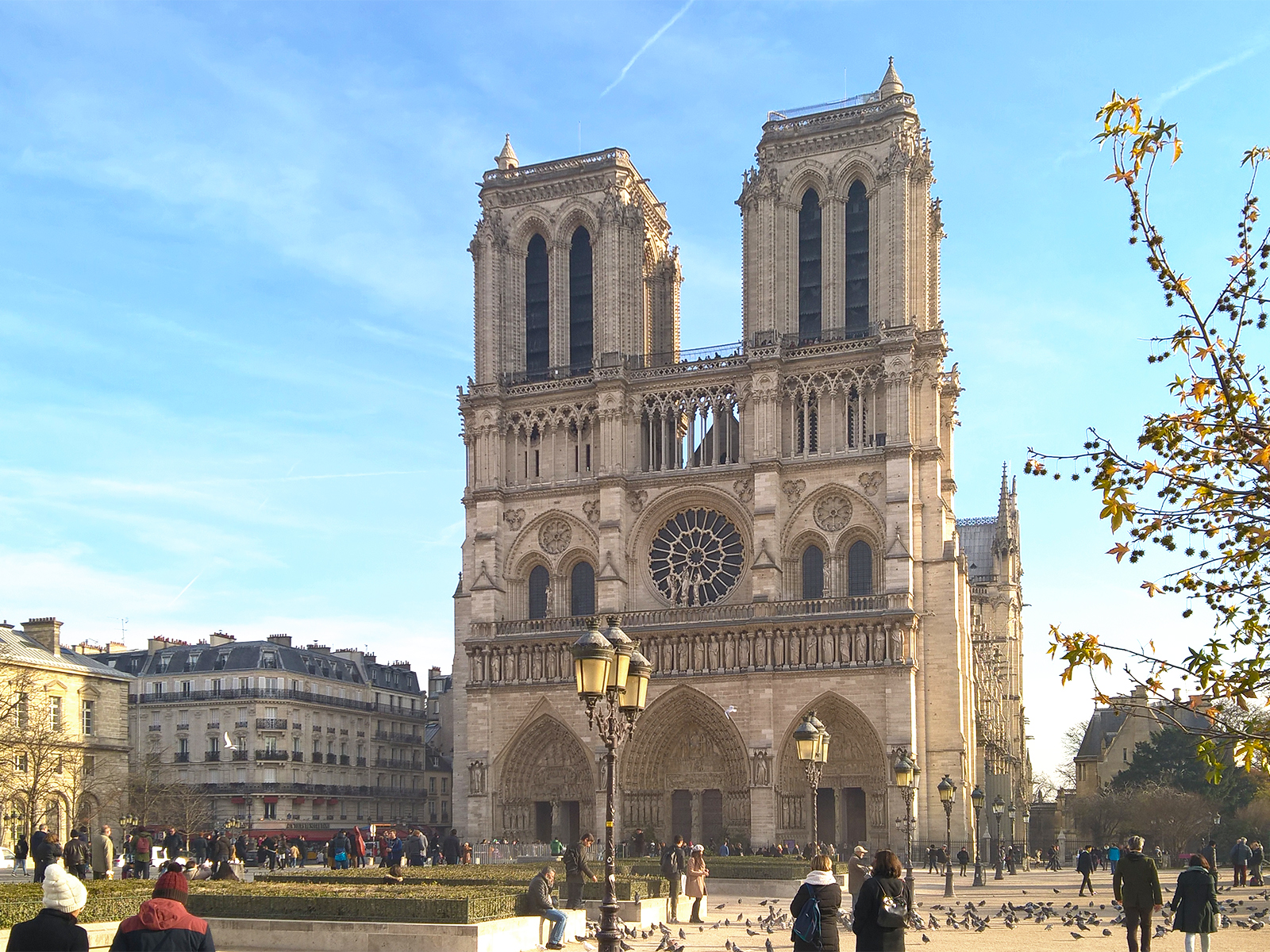
Victor Hugo reportedly didn’t hide his anger toward the imprudent demolition of the old buildings and the disorderly reconstruction in a destructive manner; accordingly, his argument proves his profound perception about history and architecture. Through various metaphors, he says that the mankind has engraved the legacy within the edifices and has conveyed those achievements to the following generation; then he declares that the role of architecture will be replaced by the publication unleashed by the invention of type printing.
Architecture then is developed with the human thought; it came into a giant with a thousand heads and a thousand arms; it fixed all the floating symbolism in an eternal, visible, and palpable form. While Daedalus, who is power, measured, while Orpheus, who is intelligence, sang, the pillar which is a letter, the arcade which is a syllable, and the pyramid which is a word, set in motion by both a law of geometry and a law of poetry, grouped, combined, amalgamated, descended, ascended, juxtaposed themselves on the ground, and stood in the sky, until they had written, according to the dictation of the general idea of an epoch, those marvelous books which were also marvelous edifices; The pagoda of Eklingji, the Ramesseum of Egypt, the Temple of Solomon.
(…)
In the fifteenth century, everything changes.
Human thought discovers a means of perpetuating not only more durable and resistant than architecture but also simpler and easier. Architecture is dethroned. The letters of stone of Orpheus will succeed to the letters of lead of Gutenberg.
The book will kill the edifice.**
Looking back on these words through the cathedral, the church was not just a place for the rigorous ritual; it was the Bible itself. Once the Bible, the foundation of the Catholic doctrine, was communicated only by the manuscript and available only to the priest; the people of this age sincerely inscribed the Bible to the walls and the pillars of church and dedicated innumerable symbols and sacred objects. They perceived the language of God through the space where lasts the eternal time of the Bible, from the creation of the world to the last judgment.
The countless people read the Bible that is published in large quantities and then criticized the secular authority of religion; nevertheless, the churches were built bigger and higher for a long time. Furthermore, the walls and vaults of the cathedrals were marvelously painted and the aisles were filled with the splendid sculptures. The priests didn’t hesitate to spend enormous manpower and property to preserve the temporal legacy. Finally, only the arrogantly skillful aestheticism remained in the spectacular space, extruding the divine language as guidance of life.
Today, in the info-communication innovation era over the printing revolution, the Saint Moritz Church in Augsburg, Germany, includes the words of God and the times of the Bible in a different way. Built nearly 1000 years ago and mostly destroyed by a bombardment in World War II, following several restorations and improvements, the church reopened its door with the last interior renovation that shows an excessive minimalism. As scraped with a giant chisel, white walls and dark oak wood chairs on the stone paving only come in sight without any superfluous elements. Considering the church is not a Lutheran church and compared with other churches that are often obsessed to restore and preserve the initial state, it is unexpected.

It doesn’t mean that all the sacred works have been removed. Most of them are just located in different places. The statues formerly attached to the pillars of the nave are now put in the alcoves of each aisle. The equipment is modernized, including lighting and heating. The white hemispheres shaped along the vault are installed, concealing the LED bulbs. The underfloor heating system removed unattractive radiators. The intention of architects and designers, who try to derive a clearer comprehension of the space that looks natural as it was initially while by exquisitely redrawing each element of the church and by improving the technical performance, seems successful.

The monochrome simplicity denotes a willingness to tear down the trace of worldly desire and to come closer to the essence of space. The void intends a way back to the origin of the church by filling the purity with the divine language. Facing that substance, the erased abundance and the unveiled words of God, without any paintings and sculptures, we see the marvelous quickness of time implying both the tiny moment and the eternity.
* GLOSSA IN EPISTOLAS D. PAULI. Norimbergae, Antonius Koburger, 1474 : GLOSSA IN EPISTOLAS PAULI, PETRUS LOMBARDUS (1100-1160)
** Notre-Dame de Paris, Victor Hugo, Livre V Chapitre II (Edition Gallimard pp. 283 – 290), translation in English ©J-W.HWANG

 J-W.H/A+U&D